It should come as no surprise to any reader of The G-CAT that I’m a firm believer against the false dichotomy (and yes, I really do love that phrase) of “nature versus nurture.” Primarily, this is because the phrase gives the impression of some kind of counteracting balance between intrinsic (i.e. usually genetic) and extrinsic (i.e. usually environmental) factors and how they play a role in behaviour, ecology and evolution. While both are undoubtedly critical for adaptation by natural selection, posing this as a black-and-white split removes the possibility of interactive traits.
The real Circle of Life. Not only do genes and the environment interact with one another, but genes may interact with other genes and environments may be complex and multi-faceted.
A very simplified example of adaptation from genetic variation. In this example, we have two different alleles of a single gene (orange and blue). Natural selection favours the blue allele so over time it increases in frequency. The difference between these two alleles is at least one base pair of DNA sequence; this often arises by mutation processes.
Despite how important the underlying genes are for the formation of proteins and definition of physiology, they are not omnipotent in that regard. In fact, many other factors can influence how genetic traits relate to phenotypic traits: we’ve discussed a number of these in minor detail previously. An example includes interactions across different genes: these can be due to physiological traits encoded by the cumulative presence and nature of many loci (as in quantitative trait loci and polygenic adaptation). Alternatively, one gene may translate to multiple different physiological characters if it shows pleiotropy.
Differential expression
One non-direct way genetic information can impact on the phenotype of an organism is through something we’ve briefly discussed before known as differential expression. This is based on the notion that different environmental pressures may affect the expression (that is, how a gene is translated into a protein) in alternative ways. This is a fundamental underpinning of what we call phenotypic plasticity: the concept that despite having the exact same (or very similar) genes and alleles, two clonal individuals can vary in different traits. The is related to the example of genetically-identical twins which are not necessarily physically identical; this could be due to environmental constraints on growth, behaviour or personality.
An example of differential expression in wild populations of southern pygmy perch, courtesy of Brauer et al. (2017). In this figure, each column represents a single individual fish, with the phylogenetic tree and coloured boxes at the top indicating the different populations. Each row represents a different gene (this is a subset of 50 from a much larger dataset). The colour of each cell indicates whether the expression of that gene is expressed more (red) or less (blue) than average. As you can see, the different populations can clearly be seen within their expression profiles, with certain genes expressing more or less in certain populations.
The discovery of epigenetic markers and their influence on gene expression has opened up the possibility of understanding heritable traits which don’t appear to be clearly determined by genetics alone. For example, research into epigenetics suggest that heritable major depressive disorder (MDD) may be controlled by the expression of genes, rather than from specific alleles or genetic variants themselves. This is likely true for a number of traits for which the association to genotype is not entirely clear.
Epigenetic adaptation?
From an evolutionary standpoint again, epigenetics can similarly influence the ‘bang for a buck’ of particular genes. Being able to translate a single gene into many different forms, and for this to be linked to environmental conditions, allows organisms to adapt to a variety of new circumstances without the need for specific adaptive genes to be available. Following this logic, epigenetic variation might be critically important for species with naturally (or unnaturally) low genetic diversity to adapt into the future and survive in an ever-changing world. Thus, epigenetic information might paint a more optimistic outlook for the future: although genetic variation is, without a doubt, one of the most fundamental aspects of adaptability, even horrendously genetically depleted populations and species might still be able to be saved with the right epigenetic diversity.
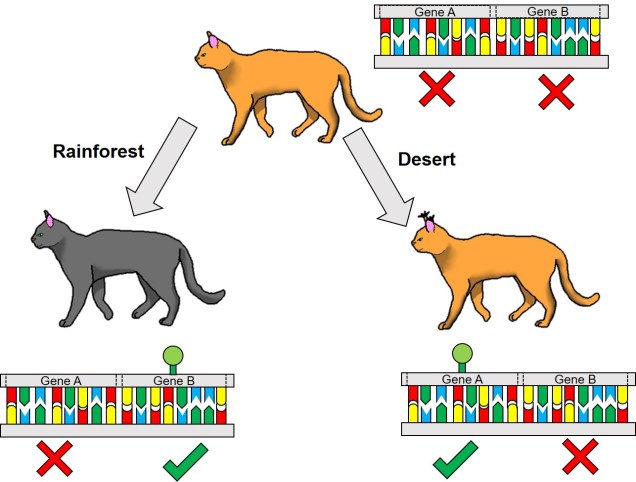
A relatively simplified example of adaptation from epigenetic variation. In this example, we have a species of cat; the ‘default’ cat has non-tufted ears and an orange coat. These two traits are controlled by the expression of Genes A and B, respectively: in the top cat, neither gene is expressed. However, when this cat is placed into different environments, the different genes are “switched on” by epigenetic factors (the green markers). In a rainforest environment, the dark foliage makes darker coat colour more adaptive; switching on Gene B allows this to happen. Conversely, in a desert environment switching on Gene A causes the cat to develop tufts on its ears, which makes it more effective at hunting prey hiding in the sands. Note that in both circumstances, the underlying genetic sequence (indicated by the colours in the DNA) is identical: only the expression of those genes change.
Epigenetic research, especially from an ecological/evolutionary perspective, is a very new field. Our understanding of how epigenetic factors translate into adaptability, the relative performance of epigenetic vs. genetic diversity in driving adaptability, and how limited heritability plays a role in adaptation is currently limited. As with many avenues of research, further studies in different contexts, experiments and scopes will reveal further this exciting new aspect of evolutionary and conservation genetics. In short: watch this space! And remember, ‘nature is nurture’ (and vice versa)!
Managing and conserving threatened and endangered species in the wild is a difficult process. There are a large number of possible threats, outcomes, and it’s often not clear which of these (or how many of these) are at play at any one given time. Thankfully, there are also a large number of possible conservation tools that we might be able to use to protect, bolster and restore species at risk.
A diagram of the hierarchy of structure within a species. Remember that ESUs, by definition, should be evolutionary different from one another (i.e. adaptively divergent) whilst MUs are not necessarily divergent to the same degree.
This can lead to a particular paradigm of conservation management: keeping everything separate and pure is ‘best practice’. The logic is that, as these different groups have evolved slightly differently from one another (although there is often a lot of grey area about ‘differently enough’), mixing these groups together is a bad idea. Particularly, this is relevant when we consider translocations (“it’s never acceptable to move an organism from one ESU into another”) and captive breeding programs (“it’s never acceptable to breed two organisms together from different ESUs”). So, why not? Why does it matter if they’re a little different?
Outbreeding depression
Well, the classic reasoning is based on a concept called ‘outbreeding depression’. We’ve mentioned outbreeding depression before, and it is a key concept kept in mind when developing conservation programs. The simplest explanation for outbreeding depression is that evolution, through the strict process of natural selection, has pushed particularly populations to evolve certain genetic variants for a certain selective pressure. These can vary across populations, and it may mean that populations are locally adapted to a specific set of environmental conditions, with the specific set of genetic variants that best allow them to do this.
However, when you mix in the genetic variants that have evolved in a different population, by introducing a foreign individual and allowing them to breed, you essentially ‘tarnish’ the ‘pure’ gene pool of that population with what could be very bad (maladaptive) genes. The hybrid offspring of ‘native’ and this foreign individual will be less adaptive than their ‘pure native’ counterparts, and the overall adaptiveness of the population will decrease as those new variants spread (depending on the number introduced, and how negative those variants are).
An example of how outbreeding depression can affect a species. The original red fish population is not doing well- it is of conservation concern, and has very little genetic diversity (only the blue gene in this example). So, we decide to introduce new genetic diversity by adding in green fish, which have the orange gene. However, the mixture of the two genes and the maladaptive nature of the orange gene actually makes the situation worse, with the offspring showing less fitness than their preceding generations.
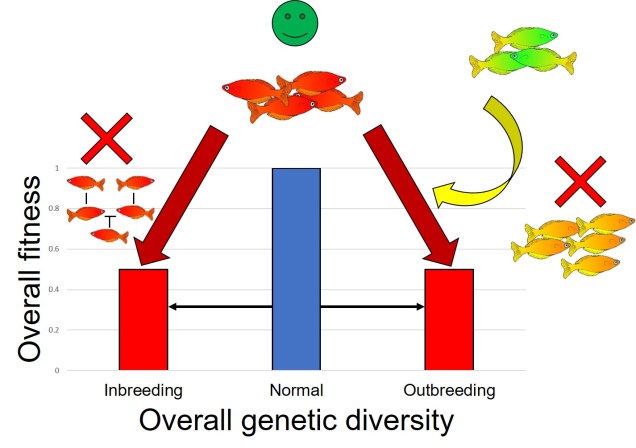
You might be familiar with inbreeding depression, which is based on the loss of genetic diversity from having too similar individuals breeding together to produce very genetically ‘weak’ offspring through inbreeding. Outbreeding depression could be thought of as the opposite extreme; breeding too different individuals introduced too many ‘bad’ alleles into the population, diluting the ‘good’ alleles.
An overly simplistic representation of how inbreeding and outbreeding depression can reduce overall fitness of a species. In inbreeding depression, the lack of genetic diversity due to related individuals breeding with one another makes them at risk of being unable to adapt to new pressures. Contrastingly, adding in new genes from external populations which aren’t fit for the target population can also reduce overall fitness by ‘diluting’ natural, adaptive allele frequencies in the population.
Genetic rescue
It might sound awfully purist to only preserve the local genetic diversity, and to assume that any new variants could be bad and tarnish the gene pool. And, surprisingly enough, this is an area of great debate within conservation genetics.
An example of genetic rescue. This circumstance is identical to the one above, with the key difference being in the fitness of the introduced gene. The orange gene in this example is actually beneficial to the target population: by providing a new, adaptive allele for natural selection to act upon, overall fitness is increased for the red fish population.
The balance
So, what’s the balance between the two? Is introducing new genetic variation a bad idea, and going to lead to outbreeding depression; or a good idea, and lead to genetic rescue? Of course, many of the details surrounding the translocation of new genetic material is important: how different are the populations? How different are the environments (i.e. natural selection) between them? How well will the target population take up new individuals and genes?
Overall, however, the more recent and well-supported conclusion is that fears regarding outbreeding depression are often strongly exaggerated. Bad alleles that have been introduced into a population can be rapidlypurged by natural selection, and the likelihood of a strongly maladaptive allele spreading throughout the population is unlikely. Secondly, given the lack of genetic diversity in the target population, most that need the genetic rescue are so badly maladaptive as it is (due to genetic drift and lack of available adaptive alleles) that introducing new variants is unlikely to make the situation much worse.
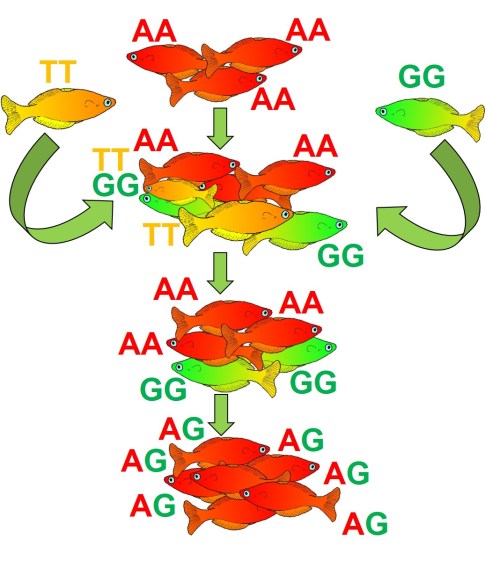
An example of how introducing maladaptive alleles might not necessarily lead to decreased fitness. In this example, we again start with our low diversity red fish population, with only one allele (AA). To help boost genetic diversity, we introduce orange fish (with the TT allele) and green fish (with the GG allele) into the population. However, the TT allele is not very adaptive in this new environment, and individuals with the TT gene quickly die out (i.e. be ‘purged’). Individual with the GG gene, however, do well, and continue to integrate into the red population. Over time, these two variants will mix together as the two populations hybridise and overall fitness will increase for the population.
That said, outbreeding depression is not an entirely trivial concept and there are always limitations in genetic rescue procedures. For example, it would be considered a bad idea to mix two different species together and make hybrids, since the difference between two species, compared to two populations, can be a lot stronger and not necessarily a very ‘natural’ process (whereas populations can mix and disjoin relatively regularly).
The reality of conservation management
Conservation science is, at its core, a crisis discipline. It exists solely as an emergency response to the rapid extinction of species and loss of biodiversity across the globe. The time spent trying to evaluate the risk of outbreeding depression – instead of immediately developing genetic rescue programs – can cause species to tick over to the afterlife before we get a clear answer. Although careful consideration and analysis is a requirement of any good conservation program, preventing action due to almost paranoid fear is not a luxury endangered species can afford.
The classic way for new genetic variants to appear is often thought of as mutation: changes in a single base in the DNA are caused by various external processes such as chemical, physical or environmental influences (such as the sci-fi classics like UV rays or toxic chemicals). Although these forms of mutations happen very rarely and certainly don’t have the same effects comic books would leave you to believe, new mutations can occur relatively rapidly depending on the characteristics of the species. However, the most common way for new mutations to occur is actually part of the DNA replication process: copying DNA is not always perfect and even though the relevant proteins essentially run a spellcheck, sometimes the copy is not 100% perfect and new mutations occur.
An example of how adaptation can occur from a new mutation. In this example, we have one gene (TTXTT), with initial only one allele (variant), TTATT. In the second generation (row), a mutation occurs in one individual which creates a new, second allele: TTGTT. This allele is favoured over the TTATT allele, and in the next generation it’s frequency increases as the alternative allele frequency decreases (the pattern is shown in the frequency values on the right side).
Alternatively, genetic variation might already be present within a species or population. This is more likely if population sizes are large and populations are well connected and interbreeding. We refer to this diverse initial gene pool as ‘standing genetic variation’: that is, the amount of genetic variation within the population or species before the selective pressure requiring adaptation. Standing genetic variation can be thought of as the ‘diversity of choices’ for natural selection to act upon: the variants are readily available, and if a good choice exists it will be favoured by natural selection and become more widespread within the population or species (i.e. evolve).
A slightly more complex example of how adaptation can occur from standing variation, this time with two different genes. One codes for fur colour, with two different alleles: GCATA codes for orange fur, and GCGTA codes for grey fur. The other gene codes for ear tufts, with TTCCT coding for tufts and TCCCT coding for no tufts. Natural selection favours both orange fur and tufted ears, and cats with these traits reproduce more frequently than those without (see graph below). These cats probably look familiar.The frequency of all four alleles (i.e. either allele for both genes) over the generations in the above figure. Clearly, we can see how adaptation rapidly favours orange fur and tufted ears over grey fur and non-tufted ears with the shifts in frequencies over the different alleles.
We’ve discussed standing genetic variation before on The G-CAT, but often in a different light (and phrasing). For example, when we’ve talked about founder effect: that is, when a population is formed from only a few different individuals which causes it to be very genetically depauperate. In populations under strong founder effect, there is very little standing genetic variation for natural selection to act upon. This has long been an enigma for many pest species: how have they managed to proliferate so widely when they often originate from so few individuals and lack genetic diversity?
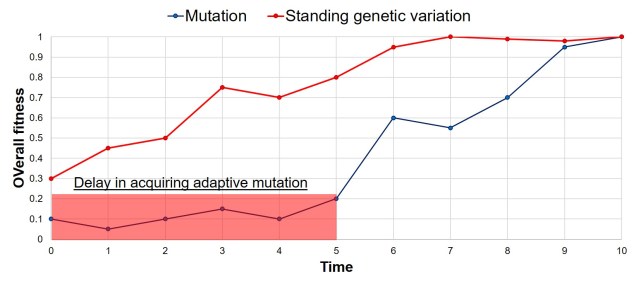
A rough example of the speed of adaptation depending on how the adaptive allele originated: whether it was already present (in the form of standing variation), or whether it was created by a new mutation. As one would expect, there is a significant lag delay in adaptation in the mutation scenario, based on the time it takes for said adaptive mutation to be created through relatively random processes. Thus, a positively selected allele from standing variation can allow a species to adapt much faster than waiting for a positive mutation to occur.
An extreme example of alternate splicing of one gene. We start with a single gene, composed of 5 (A–E) main gene elements (exons). Different environmental pressures (like fire risk, flooding, cold weather or predators, for example) cause the organism to use different combinations of these exons to make different proteins (right side; A–D). Actual alternate splicing is not usually this straight-forward (one gene doesn’t conveniently split into four forms depending on the threat), but the process is generally the same.
Evolution is a constant, endless force which seeks to push and shape species based on the context of their environment: sometimes rapidly, sometimes much more gradually. Although we often think of discrete points of evolution (when one species becomes two, when a particular trait evolves), it is nevertheless a continual force that influences changes in species. These changes are often difficult to ‘unevolve’ and have a certain ‘evolutionary inertia’ to them; because of these factors, it’s often critical to understand how a history of evolution has generated the organisms we see today.
What do I mean when I say evolutionary history? Well, the term is fairly diverse and can relate to the evolution of particular traits or types of traits, or the genetic variation and changes related to these changes. The types of questions and points of interest of evolutionary history can depend at which end of the timescale we look at: recent evolutionary histories, and the genetics related to them, will tell us different information to very ancient evolutionary histories. Let’s hop into our symbolic DeLorean and take a look back in time, shall we?
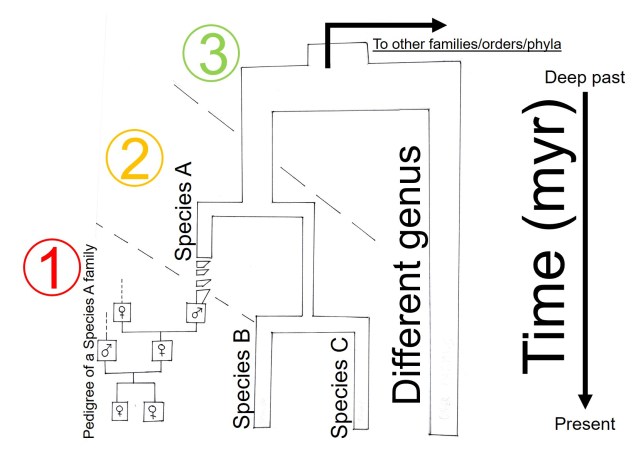
A timeslice of evolutionary history (a pseudo-phylogenetic tree, I guess?), going from more recent history (bottom left) to deeper history (top right). Each region denoted in the tree represents the generally area of focus for each of the following blog headings. 1: Recent evolutionary history might look at individual pedigrees, or comparing populations of a single species. 2: Slightly older comparisons might focus on how species have arisen, and the factors that drive this (part of ‘phylogeography’). 3: Deep history might focus on the origin of whole groups of organisms and a focus on the evolution of particular traits like venom or sociality.
Very recent evolutionary history: pedigrees and populations
While we might ordinarily consider ‘evolutionary history’ to refer to events that happened thousands or millions of years ago, it can still be informative to look at history just a few generations ago. This often involves looking at pedigrees, such as in breeding programs, and trying to see how very short term and rapid evolution may have occurred; this can even include investigating how a particular breeding program might accidentally be causing the species to evolve to adapt to captivity! Rarely does this get referred to as true evolutionary history, but it fits on the spectrum, so I’m going to count it. We might also look at how current populations are evolving differently to one another, to try and predict how they’ll evolve into the future (and thus determine which ones are most at risk, which ones have critically important genetic diversity, and the overall survivability of the total species). This is the basis of ‘evolutionarily significant units’ or ESUs which we previously discussed on The G-CAT.
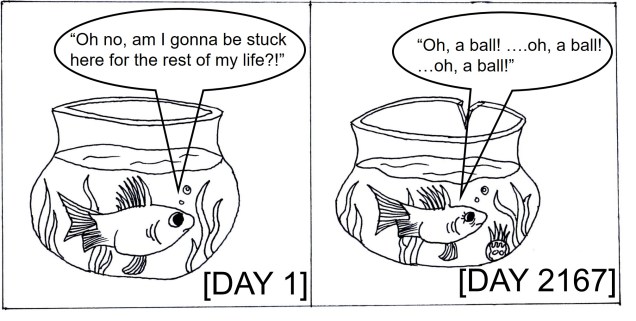
Maybe goldfish evolved 3 second memory to adapt to the sheer boringness of captivity? …I’m joking, of course: the memory thing is a myth and adaptation works over generations, not a lifetime.
A little further back: phylogeography and species
A little further back, we might start to look at how different populations have formed or changed in semi-recent history (usually looking at the effect of human impacts: we’re really good at screwing things up I’m sorry to say). This can include looking at how populations have (or have not) adapted to new pressures, how stable populations have been over time, or whether new populations are being ‘made’ by recent barriers. At this level of populations and some (or incipient) species, we can find the field of ‘phylogeography’, which involves the study of how historic climate and geography have shaped the evolution of species or caused new species to evolve.
An example of trait-based phylogenetics, looking at the biogeographic patterns and evolution/migration to freshwater in perch-like fishes, by Chen et al. (2014). The phylogeny shows that a group of fishes adapted to freshwater environments (black) from a (likely) saltwater ancestor (white), with euryhaline tolerance evolving two separate times (grey).
One high profile example of phylogeographic studies is the ‘Out of Africa’ hypothesis and debate for the origination of the modern human species. Although there has been no shortage of debate about the origin of modern humans, as well as the fate of our fellow Neanderthals and Denisovans, the ‘Out of Africa’ hypothesis still appears to be the most supported scenario.
A generalised diagram of the ‘Out of Africa’ hypothesis of human migration, from Oppenheimer, 2012.
Phylogeography is also component for determining and understanding ‘biodiversity hotspots’; that is, regions which have generated high levels of species diversity and contain many endemic species and populations, such as tropical hotspots or remote temperate regions. These are naturally of very high conservation value and contribute a huge amount to Earth’s biodiversity, ecological functions and potential for us to study evolution in action.
Deep, deep history: phylogenetics and the origin of species (groups)
Even further back, we start to delve into the more traditional concept of evolutionary history. We start to look at how species have formed; what factors caused them to become new species, how stable the new species are, and what are the genetic components underlying the change. This subfield of evolution is called ‘phylogenetics’, and relates to understanding how species or groups of species have evolved and are related to one another.
Sometimes, this includes trying to look at how particular diagnostic traits have evolved in a certain group, like venom within snakes or eusocial groups in bees. Phylogenetic methods are even used to try and predict which species of plants might create compounds which are medically valuable (like aspirin)! Similarly, we can try and predict how invasive a pest species may be based on their phylogenetic (how closely related the species are) and physiological traits in order to safeguard against groups of organisms that are likely to run rampant in new environments. It’s important to understand how and why these traits have evolved to get a good understanding of exactly how the diversity of life on Earth came about.
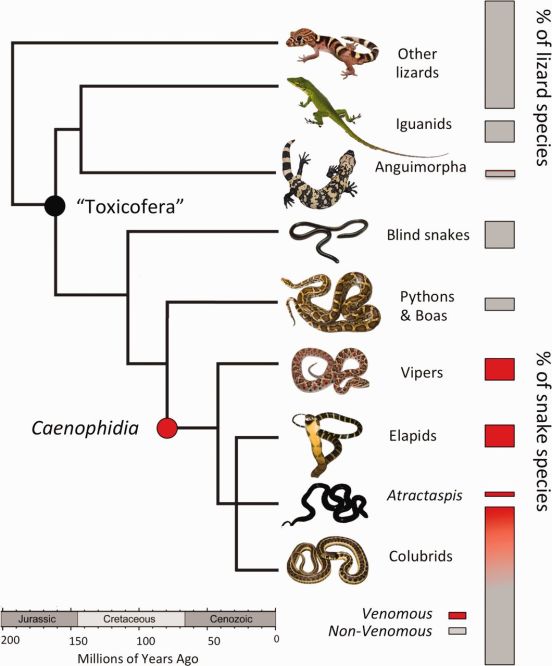
An example of looking at trait evolution with phylogenetics, focusing on the evolution of venom in snakes, from Reyes-Velasco et al. (2014). The size of the boxes demonstrates the number of species in each group, with the colours reflecting the number of venomous (red) vs. non-venomous (grey) species. The red dot shows the likely origin of venom.
Phylogenetics also allows us to determine which species are the most ‘evolutionarily unique’; all the special little creatures of plant Earth which represent their own unique types of species, such as the tuataraor the platypus. Naturally, understanding exactly how precious and unique these species are suggests we should focus our conservation attention and particularly conserve them, since there’s nothing else in the world that even comes close!
Who cares what happened in the past right? Well, I do, and you should too! Evolution forms an important component of any conservation management plan, since we obviously want to make sure our species can survive into the future (i.e. adapt to new stressors). Trying to maintain the most ‘evolvable’ groups, particularly within breeding programs, can often be difficult when we have to balance inbreeding depression (not having enough genetic diversity) with outbreeding depression (obscuring good genetic diversity by adding bad genetic diversity into the gene pool). Often, we can best avoid these by identifying which populations are evolutionarily different to one another (see ESUs) and using that as a basis, since outbreeding vs. inbreeding depression can be very difficult to measure. This all goes back to the concept of ‘adaptive potential’ that we’ve discussed a few times before.
In any case, a keen understanding of the evolutionary trajectory of a species is a crucial component for conservation management and to figure out the processes and outcomes of evolution in the real world. Thus, evolutionary history remains a key area of research for both conservation and evolution-related studies.










 The G-cat