The direction of selection

The nature of adaptation

One of the most fundamental aspects of natural selection and evolution is, of course, the underlying genetic traits that shape the physical, selected traits. Most commonly, this involves trying to understand how changes in the distribution and frequencies of particular genetic variants (alleles) occur in nature and what forces of natural election are shaping them. Remember that natural selection acts directly on the physical characteristics of species; if these characteristics are genetically-determined (which many are), then we can observe the flow-on effects on the genetic diversity of the target species.

Although we might expect that natural selection is a fairly predictable force, there are a myriad of ways it can shape, reduce or maintain genetic diversity and identity of populations and species. In the following examples, we’re going to assume that the mentioned traits are coded for by a single gene with two different alleles for simplicity. Thus, one allele = one version of the trait (and can be used interchangeably). With that in mind, let’s take a look at the three main broad types of changes we observe in nature.

Directional selection

Arguably the most traditional perspective of natural selection is referred to as ‘directional selection’. In this example, nature selection causes one allele to be favoured more than another, which causes it to increase dramatically in frequency compared to the alternative allele. The reverse effect (natural selection pushing against a maladaptive allele) is still covered by directional selection, except that it functions in the opposite way (the allele under negative selection has reduced frequency, shifting towards the alternative allele).
Directional selection diagram
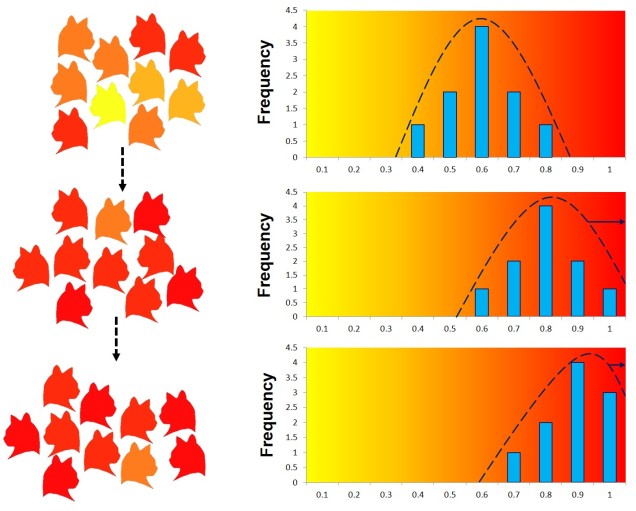
An example of directional selection. In this instance, we have one population of cats and a single phenotypic trait (colour) which ranges from 0 (yellow) to 1 (red). Red colour is selected for above all other colours; the original population has a pretty diverse mix of colours to start. Over time, we can see the average colour of the entire population moves towards more red colours whilst yellow colours start to disappear. Note that although the final population is predominantly red, there is still some (minor) variation in colours. These changes are reflected in the distribution of the colour-coding alleles (right), as it moves towards the red end of the spectrum.

Balancing selection

Natural selection doesn’t always push allele frequencies into different directions however, and sometimes maintains the diversity of alleles in the population. This is what happens in ‘balancing selection’ (sometimes also referred to as ‘stabilising selection’). In this example, natural selection favours non-extreme allele frequencies, and pushes the distribution of allele frequencies more to the centre. This may happen if deviations from the original gene, regardless of the specific change, can have strongly negative effects on the fitness of an organism, or in genes that are most fit when there is a decent amount of variation within them in the population (such as the MHC region, which contributes to immune response). There are a couple other reasons balancing selection may occur, though.

Heterozygote advantage

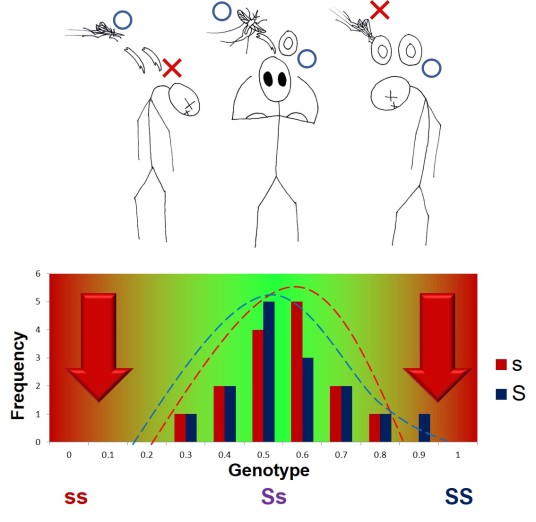
One example is known as ‘heterozygote advantage’. This is when an organism with two different alleles of a particular gene has greater fitness than an organism with two identical copies of either allele. A seemingly bizarre example of heterozygote advantage is related to sickle cell anaemia in African people. Sickle cell anaemia is a serious genetic disorder which is encoded for by recessive alleles of a haemoglobin gene; thus, a person has to carry two copies of the disease allele to show damaging symptoms. While this trait would ordinarily be strongly selected against in many population, it is maintained in some African populations by the presence of malaria. This seems counterintuitive; why does the presence of one disease maintain another?

Well, it turns out that malaria is not very good at infecting sickle cells; there are a few suggested mechanisms for why but no clear single answer. Naturally, suffering from either sickle cell anaemia or malaria is unlikely to convey fitness benefits. In this circumstance, natural selection actually favours having one sickle cell anaemia allele; while being a carrier isn’t ordinarily as healthy as having no sickle cell alleles, it does actually make the person somewhat resistant to malaria. Thus, in populations where there is a selective pressure from malaria, there is a heterozygote advantage for sickle cell anaemia. For those African populations without likely exposure to malaria, sickle cell anaemia is strongly selected against and less prevalent.
Malaria and sickle diagram
A diagram of how heterozygote advantage works in sickle cell anaemia and malaria resistance. On the top we have our two main traits: the blood cell shape (which has two different alleles; normal and sickle celled) and malaria infection by mosquitoes. Blue circles indicate that the trait has good fitness, whilst red crosses indicate the trait has bad fitness. For the left hand person, having two sickle cell alleles (ss) means they are symptomatic of sickle cell anaemia and is unlikely to have a good quality of life. On the right, having two normal blood cell alleles (SS) means that he is susceptible to malaria infection. The middle person, however, having only one sickle cell allele (Ss) means they are asymptomatic but still resistant to malaria. Thus, being heterozygous for sickle cell is actually beneficial over being homozygous in either direction: this is reflected in the distribution of alleles (bottom). The left side is pushed down by sickle cell anaemia whilst the right side is pushed down by malaria, thus causing both blood cell alleles (s and S) to be maintained at an intermediate frequency (i.e. balanced). 

Frequency-dependent selection

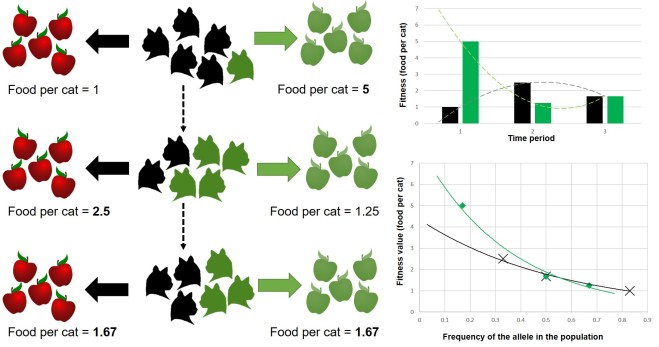
Another form of balancing selection is called ‘frequency-dependent selection’, where the fitness of an allele is inversely proportional to its frequency. Thus, once the allele has become common due to selection, the fitness of that allele is reduced and selection will start to favour the alternative allele (which is at much lower frequency). The constant back-and-forth tipping of the selective scales results in both alleles being maintained at an equilibrium.

This can happen in a number of different ways, but often the rarer trait/allele is fundamentally more fit because of its rarity. For example, if one allele allows an individual to use a new food source, it will be very selectively fit due to the lack of competition with others. However, as that allele accumulates within the population and more individuals start to feed on that food source, the lack of ‘uniqueness’ will mean that it’s not particularly better than the original food source. A balance between the two food sources (and thus alleles) will be maintained over time as shifts towards one will make the other more fit, and natural selection will compensate.
Frequency dependent selection diagram
An example of frequency-dependent selection. The colour of the cat indicates both their genotype and their food sources: black cats eat red apples whilst green cats eat green apples (this species has apparently developed herbivory, okay?) To start with, the incredibly low frequency of green cats mean that the one green cat can exploit a huge food source compared to black cats. Because of this, natural selection favours green cats. However, in the next generation evolution overcompensates and produces way too many green cats, and now black cats are getting much more food. Natural selection bounces back to favour black cats. Eventually, this causes and equilibrium balance of the two cat types (as shifts one way will cause a shift back the other way immediately after). These changes are reflected in the overall frequency of the two types over time (top right), which eventually evens out. The bottom right figure demonstrates that for both cat types, the frequency of that colour is inversely proportional to the overall fitness (measured as a proxy by amount of food per cat).

Disruptive selection

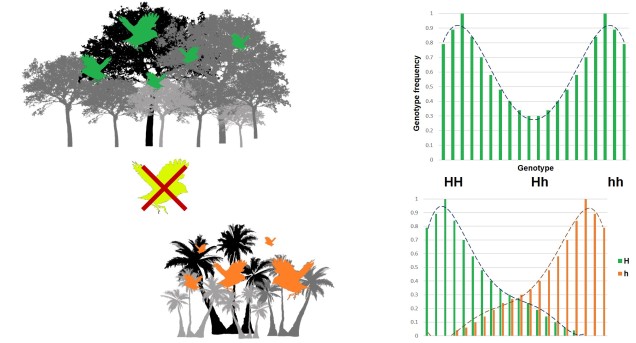
A third category of selection (although not as frequently mentioned) is known as ‘disruptive selection’, which is essentially the direct opposite of balancing selection. In this case, both extremes of allele frequencies are favoured (e.g. 1 for one allele or 1 for the other) but intermediate frequencies are not. This can be difficult to untangle in natural populations since it could technically be attributed to two different cases of directional selection. Each allele of the same gene is directionally selected for, but in opposite populations and directions so that overall pattern shows very little intermediates.

In direct contrast to balancing selection, disruptive selection can often be a case of heterozygote disadvantage (although it’s rarely called that). In these examples, it may be that individuals which are not genetically committed to one end or the other of the frequency spectrum are maladapted since they don’t fit in anywhere. An example would be a species that occupies both the desert and a forested area, with little grassland-type habitat in the middle. For the relevant traits, strongly desert-adapted genes would be selected for in the desert and strongly forest-adapted genes would be selected for in the forest. However, the lack of gradient between the two habitats means that individuals that are half-and-half are less adaptive in both the desert and the forest. A case of jack-of-all-trades, master of none.
Disruptive selection diagram
The above example of disruptive selection. Bird colour is coded for by a single gene; green birds have a HH genotype, orange birds have a hh genotype, and yellow birds are heterozygotes (Hh). Habitats where the two homozygote colours are most adaptive are found; green birds do well in the forest whereas orange birds do well in the desert. However, there’s no intermediate habitat between the two and so yellow birds don’t really fit well anywhere; they’re outcompeted in the forest and desert by the respective other colours. This means selection favours either extreme (homozygotes), shown in the top right. If we split up the two alleles of the genotype though, we can see that this disruptive selection is really the product of two directionally selective traits working in inverse directions: H is favoured at one end and h at the other.

Direction of selection

Although it would be convenient if natural selection was entirely predictable, it often catches up by surprise in how it acts and changes species and populations in the wild. Careful analysis and understanding of the different processes and outcomes of adaptation can feed our overall understanding of evolution, and aid in at least pointing in the right direction for our predictions.
Fantastic Genes and Where to Find Them

The genetics of adaptation

Adaptation and evolution by natural selection remains one of the most significant research questions in many disciplines of biology, and this is undoubtedly true for molecular ecology. While traditional evolutionary studies have been based on the physiological aspects of organisms and how this relates to their evolution, such as how these traits improve their fitness, the genetic component of adaptation is still somewhat elusive for many species and traits.

Hunting for adaptive genes in the genome

We’ve previously looked at the two main categories of genetic variation: neutral and adaptive. Although we’ve focused predominantly on the neutral components of the genome, and the types of questions about demographic history, geographic influences and the effect of genetic drift, they cannot tell us (directly) about the process of adaptation and natural selective changes in species. To look at this area, we’d have to focus on adaptive variation instead; that is, genes (or other related genetic markers) which directly influence the ability of a species to adapt and evolve. These are directly under natural selection, either positively (‘selected for’) or negatively (‘selected against’).

Given how complex organisms, the environment and genomes can be, it can be difficult to determine exactly what is a real (i.e. strong) selective pressure, how this is influenced by the physical characteristics of the organism (the ‘phenotype’) and which genes are fundamental to the process (the ‘genotype’). Even determining the relevant genes can be difficult; how do we find the needle-like adaptive genes in a genomic haystack?

Magnifying glass figure
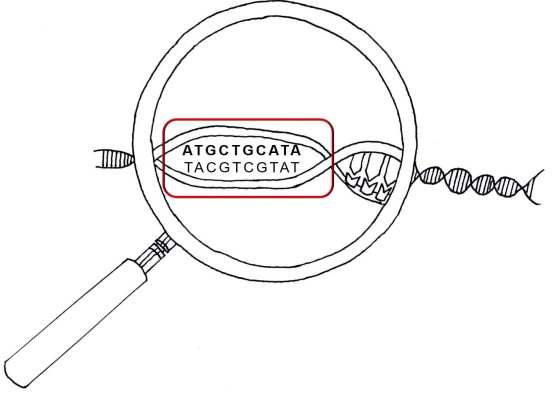
If only it were this easy.

There’s a variety of different methods we can use to find adaptive genetic variation, each with particular drawbacks and strengths. Many of these are based on tests of the frequency of alleles, rather than on the exact genetic changes themselves; adaptation works more often by favouring one variant over another rather than completely removing the less-adaptive variant (this would be called ‘fixation’). So measuring the frequency of different alleles is a central component of many analyses.

FST outlier tests

One of the most classical examples is called an ‘FST outlier test’. This can be a bit complicated without understanding what FST is actually measures: in short terms, it’s a statistical measure of ‘population differentiation due to genetic structure’. The FST value of one particular population can determine how genetically similar it is to another. An FST value of 1 implies that the two populations are as genetically different as they could possibly be, whilst an FST value of 0 implies that they are genetically identical populations.

Generally, FST reflects neutral genetic structure: it gives a background of how, on average, different are two populations. However, if we know what the average amount of genetic differentiation should be for a neutral DNA marker, then we would predict that adaptive markers are significantly different. This is because a gene under selection should be more directly pushed towards or away from one variant (allele) than another, and much more strongly than the neutral variation would predict. Thus, the alleles that are way more or less frequent than the average pattern we might assume are under selection. This is the basis of the FST outlier test; by comparing two or more populations (using FST), and looking at the distribution of allele frequencies, we can pick out a few alleles that vary from the average pattern and suggest that they are under selection (i.e. are adaptive).

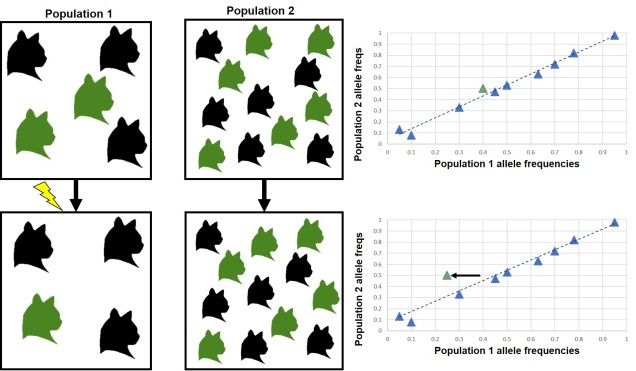
There are a few significant drawbacks for FST outlier tests. One of the most major ones is that genetic drift can also produce a large number of outliers; in a small population, for example, one allele might be fixed (has a frequency of 1, with no alternative allele in the population) simply because there is not enough diversity or population size to sustain more alleles. Even if this particular allele was extremely detrimental, it’d still appear to be favoured by natural selection just because of drift.

Drift leading to outliers diagram
An example of genetic drift leading to outliers, featuring our friends the cat population. Top row: Two cat populations, one small (left; n = 5) and one large (middle, n = 12) show little genetic differentiation between them (right; each triangle represents a single gene or locus; the ‘colour’ gene is marked in green). The average (‘neutral’) pattern of differentiation is shown by the dashed line. Much like in our original example, one cat in the small population is horrifically struck by lightning and dies (RIP again). Now when we compare the frequency of the alleles of the two populations (bottom), we see that (because a green cat died), the ‘colour’ locus has shifted away from the general trend (right) and is now an outlier. Thus, genetic drift in the ‘colour’ gene gives the illusion of a selective loci (even though natural selection didn’t cause the change, since colour does not relate to how likely a cat is to be struck by lightning).

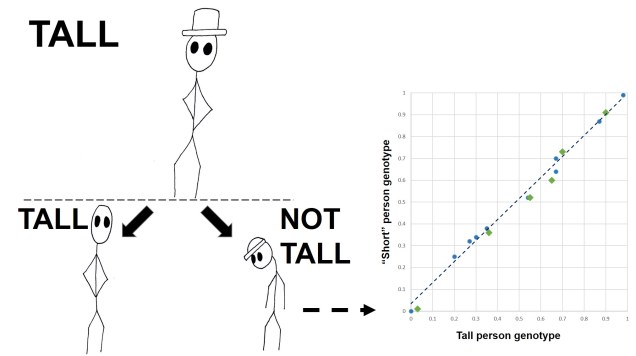
Secondly, the cut-off for a ‘significant’ vs. ‘relatively different but possibly not under selection’ can be a bit arbitrary; some genes that are under weak selection can go undetected. Furthermore, recent studies have shown a growing appreciation for polygenic adaptation, where tiny changes in allele frequencies of many different genes combine together to cause strong evolutionary changes. For example, despite the clear heritable nature of height (tall people often have tall children), there is no clear ‘height’ gene: instead, it appears that hundreds of genes are potentially very minor height contributors.

Polygenic height figure final
In this example, we have one tall parent (top) who produces two offspring; one who is tall (left) and one who isn’t (right). In order to understand what genetic factors are contributing to their height differences, we compare their genetics (right; each dot represents a single locus). Although there aren’t any particular loci that look massively different between the two, the cumulative effect of tiny differences (the green triangles) together make one person taller than the other. There are no clear outliers, but many (poly) different genes (genic) acting together.

Genotype-environment associations

To overcome these biases, sometimes we might take a more methodological approach called ‘genotype-environment association’. This analysis differs in that we select what we think our selective pressures are: often environmental characteristics such as rainfall, temperature, habitat type or altitude. We then take two types of measures per individual organism: the genotype, through DNA sequencing, and the relevant environmental values for that organisms’ location. We repeat this over the full distribution of the species, taking a good number of samples per population and making sure we capture the full variation in the environment. Then we perform a correlation-type analysis, which seeks to see if there’s a connection or trend between any particular alleles and any environmental variables. The most relevant variables are often pulled out of the environmental dataset and focused on to reduce noise in the data.

The main benefit of GEA over FST outlier tests is that it’s unlikely to be as strongly influenced by genetic drift. Unless (coincidentally) populations are drifting at the same genes in the same pattern as the environment, the analysis is unlikely to falsely pick it up. However, it can still be confounded by neutral population structure; if one population randomly has a lot of unique alleles or variation, and also occurs in a somewhat unique environment, it can bias the correlation. Furthermore, GEA is limited by the accuracy and relevance of the environmental variables chosen; if we pick only a few, or miss the most important ones for the species, we won’t be able to detect a large number of very relevant (and likely very selective) genes. This is a universal problem in model-based approaches and not just limited to GEA analysis.

New spells to find adaptive genes?

It seems likely that with increasing datasets and better analytical platforms, many more types of analysis will be developed to delve deeper into the adaptive aspects of the genome. With whole-genome sequencing starting to become a reality for non-model species, better annotation of current genomes and a steadily increasing database of functional genes, the ability of researchers to investigate evolution and adaptation at the genomic level is also increasing.

Pseudo or science? Interpreting scientific reports

Telling the real from the fake

The phrase ‘fake news’ seems to get thrown around ad nauseum these days, but there’s a reason for it (besides the original somewhat famous coining of the phrase). Inadvertently bad, or sometimes downright malicious, reporting of various apparent ‘trends’ or ‘patterns’ are rife throughout nearly all forms of media. Particularly, many entirely subjective or blatantly falsified presentations or reports of ‘fact’ cloud real scientific inquiry and its distillation into the broader community. In fact, a recent study has shown that falsified science spreads through social media at orders of magnitude faster than real science: so why is this? And how do we spot the real from the fake?

It’s imperative that we understand what real science entails to be able to separate it from the pseudoscience. Of course, scientific rigour and method are always of utmost importance, but these can be hard to detect (or can be effectively lied through colourful language choices). When reading a scientific article, whether it’s direct from the source (a journal, such as Nature or Science) or secondarily through a media outlet such as the news or online sources, there’s a few things that you should always look for that will help discern between the two categories.

Peer-review and adequate referencing

Firstly, is the science presented in an objective, logical manner? Does it systematically demonstrate the study system and question, with the relevant reference to peer-reviewed literature? Good science builds upon the wealth of previously done good science to contribute to a broader field of knowledge; in this way, critical observations and alternative ideas can be compared and contrasted to steer the broader field. Even entirely novel science, which go against the common consensus, will reference and build upon prior literature and justify the necessity and design of the study. Having written more than one literature review in my life, I can safely assure you that there is no shortage of relevant scientific studies that need to be read, understood and built upon in any future scientific study.


Methods, statistics and sampling

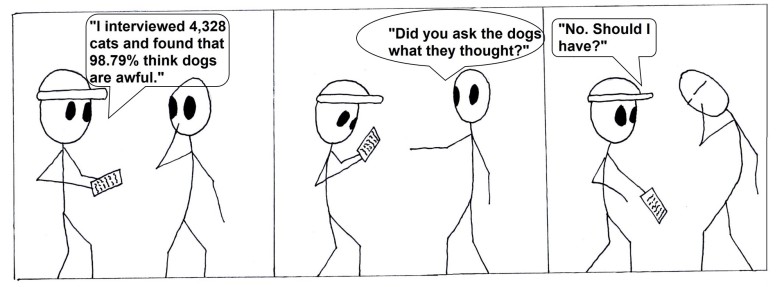
Secondly, is there a solid methodological basis for the science? In almost all cases this will include some kind of statistical measure for the validity (and accuracy) of the results. How does the sample size of the study measure up to what the target group? Remember, a study size of 500 people is definitely too small to infer the medical conditions of all humans, but rarely do we get sample sizes that big in evolutionary genetics studies (especially in non-model species). The sampling regime is extremely important for interpreting the results: particularly, keep in mind if there is an inherent bias in the way the sampling has been done. Are some groups more represented than others? Where do the samples come from? What other factors might be influencing the results, based on the origin of the samples?

Cat survey comic 2
Despite having a large sample size, and a significant result (p<0.05), this study cannot conclude that all dogs are awful. It can conclude, however, that cats are statistically significant assholes.

Presentation and language of findings

Thirdly, how does the source present the results? Does it make claims that seem beyond a feasible conclusion based on the study itself? Even if the underlying study is scientific, many secondary sources have a tendency to ‘sensationalise’ the results in order to make them both more appealing and more digestible to the general public. This is only exacerbated by the lack of information of the scientific method of the original paper, actual statistics, or the accurate summation of those statistics. Furthermore, a real scientific study will try to (in most cases) avoid evocative words such as ‘prove’, as a fundamental aspect of science is that no study is 100% ‘proven’ (see falsifiability below). Proofs are a relevant mathematical concept though, but these fall under a different category altogether.

Here’s an example: recently, an Australian mainstream media outlet (among many) shared a story about a ‘recent’ (six months old) study that found that second-born children are more likely to be criminals and first-born children have higher IQ. As you might expect, the original study does not imply that being born second will make you a sudden murderer nor will being the first born make you a prodigy. Instead, the authors suggest that there may be a link between differential parental investment/attention (between different age order children) as a potential mechanism. They ruled out, based on a wealth of statistics, the influence of alternative factors such as health or education (both in quality and quantity). Thus, there is a correlative (read: not causative) effect of age on these characteristics. If you directly interpreted the newscast (or read some of the misguided comments), you might think otherwise.

Falsifiability 

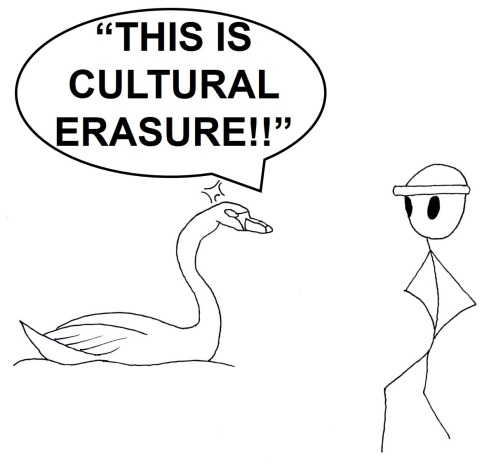
Fourthly, are the hypotheses in the study falsifiable? One of the foundations of the modern scientific method includes the requirement of any real scientific hypothesis to be falsifiable; that is, there must be a way to show evidence against that hypothesis. This can be difficult to evaluate, but is why some broad philosophical questions are considered ‘unscientific’. A classic example is the phrase “all swans are white”, which was apparently historically believed in Europe (where there are no black swans). This statement is technically falsifiable, since if one found a non-white swan it would ‘disprove’ the hypothesis. Lo and behold, Europeans arrive in Australia and find that, actually, some swans are black. The original statement was thus falsified.

Swan comic 2
Well, I’ll be damned falsified. Just pretend the swan is actually black: I don’t have enough ink to make it realistic…

The role of the peer: including you!

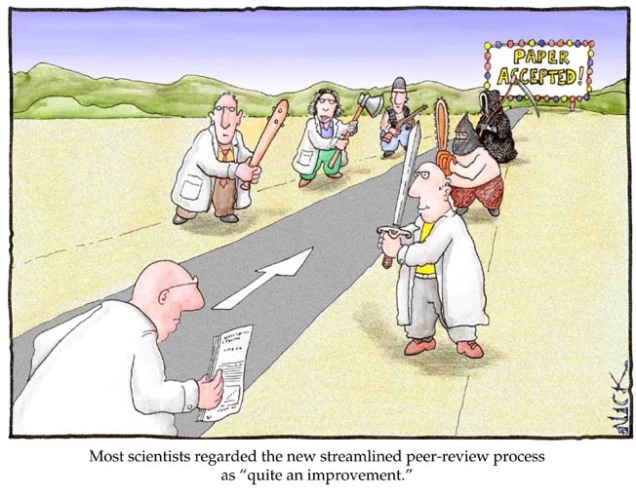
Peer-review is a critical aspect of scientific process, and despite some conspiracy-theory-esque remarks about the secret Big Science Society, it generally works. While independent people inevitably have their own personal biases and are naturally subjective to some degree (no matter how hard we may try to be objective), a larger number of well-informed, critical thinkers help to broaden the focus and perspective surrounding any scientific subject. Remember, nothing is more critical of science than science itself.

Peer review comic
One of the most apt representations of peer-review I’ve ever seen, from Dr. Nick D. Kim (PhD). Source: here.

While peer-review is technically aimed at other scientists as a way to steer and inform research, the input of outsider, non-specialist readers can still be informative. By closely looking at science, and better understanding both how it is done and what it is showing, can help us evaluate how valuable science is to broader society and shift scientific information into useful, everyday applications. Furthermore, by educating ourselves on what is real science, and what is disruptive drivel, we can aid the development of science and reduce the slowing impact of misinformation and deceit.


Evolution and the space-time continuum

Evolution travelling in time

As I’ve mentioned a few times before, evolution is a constant force that changes and flows over time. While sometimes it’s more convenient to think of evolution as a series of rather discrete events (a species pops up here, a population separates here, etc.), it’s really a more continual process. The context and strength of evolutionary forces, such as natural selection, changes as species and the environment they inhabit also changes. This is important to remember in evolutionary studies because although we might think of more recent and immediate causes of the evolutionary changes we see, they might actually reflect much more historic patterns. For example, extremely low contemporary levels of genetic diversity in cheetah is likely largely due to a severe reduction in their numbers during the last ice age, ~12 thousand years ago (that’s not to say that modern human issues haven’t also been seriously detrimental to them). Similarly, we can see how the low genetic diversity of a small population colonise a new area can have long term effects on their genetic variation: this is called ‘founder effect’. Because of this, we often have to consider the temporal aspect of a species’ evolution.

Founder effect diagram
An example of founder effect. Each circle represents a single organism; the different colours are an indicator of how much genetic diversity that individual possesses (more colours = more variation). We start with a single population; one (A) or two (B) individuals go on a vacation and decide to stay on a new island. Even after the population has become established and grows over time, it takes a long time for new diversity to arise. This is because of the small original population size and genetic diversity; this is called founder effect. The more genetic diversity in the settled population (e.g. vs A), the faster new diversity arises and the weaker the founder effect.

Evolution travelling across space

If the environmental context of species and populations are also important for determining the evolutionary pathways of organisms, then we must also consider the spatial context. Because of this, we also need to look at where evolution is happening in the world; what kinds of geographic, climatic, hydrological or geological patterns are shaping and influencing the evolution of species? These patterns can influence both neutral or adaptive processes by shaping exactly how populations or species exist in nature; how connected they are, how many populations they can sustain, how large those populations can sustainably become, and what kinds of selective pressures those populations are under.

Allopatry diagram
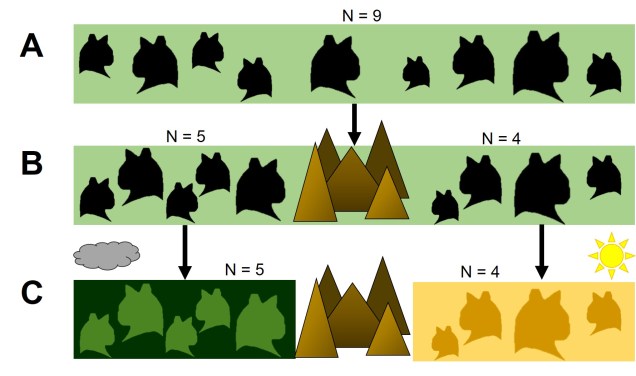
An example of how the environment (in this case, geology) can have both neutral and adaptive effects. Let’s say we start with one big population of cats (N = 9; A), which is distributed over a single large area (the green box). However, a sudden geological event causes a mountain range to uplift, splitting the population in two (B). Because of the reduced population size and the (likely) randomness of which individuals are on each side, we expect some impact of genetic drift. Thus, this is the neutral influence. Over time, these two separated regions might change climatically (C), with one becoming much more arid and dry (right) and the other more wet and shady (left). Because of the difference of the selective environment, the two populations might adapt differently. This is the adaptive influence. 

Evolution along the space-time continuum

Given that the environment also changes over time (and can be very rapid, and we’ve seen recently), the interaction of the spatial and temporal aspects of evolution are critical in understanding the true evolutionary history of species. As we know, the selective environment is what determines what is, and isn’t, adaptive (or maladaptive), so we can easily imagine how a change in the environment could push changes in species. Even from a neutral perspective, geography is important to consider since it can directly determine which populations are or aren’t connected, how many populations there are in total or how big populations can sustainably get. It’s always important to consider how evolution travels along the space-time continuum.

Genetics TARDIS
“Postgraduate Student Who” doesn’t quite have the same ring to it, unfortunately.

Phylogeography

The field of evolutionary science most concerned with these two factors and how the influence evolution is known as ‘phylogeography’, which I’ve briefly mentioned in previous posts. In essence, phylogeographers are interested in how the general environment (e.g. geology, hydrology, climate, etc) have influenced the distribution of genealogical lineages. That’s a bit of a mouthful and seems a bit complicated, by the genealogical part is important; phylogeography has a keen basis in evolutionary genetics theory and analysis, and explicitly uses genetic data to test patterns of historic evolution. Simply testing the association between broad species or populations, without the genetic background, and their environment, falls under the umbrella field of ‘biogeography’. Semantics, but important.

Birds phylogeo
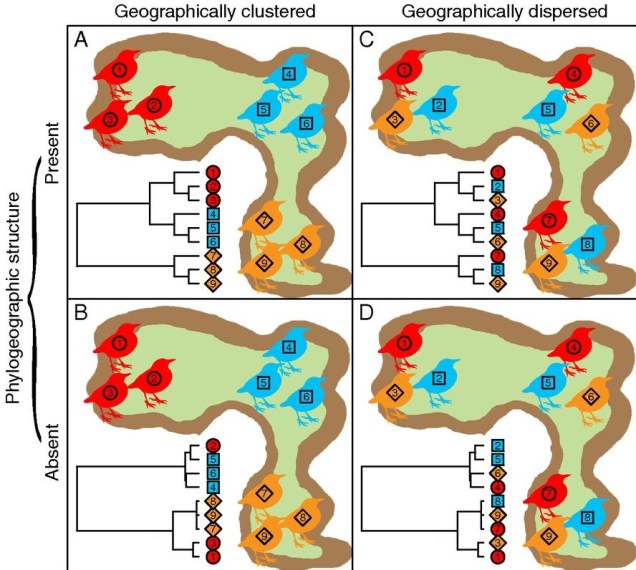
Some example phylogeographic models created by Zamudio et al. (2016). For each model, there’s a demonstrated relationship between genealogical lineages (left) and the geographic patterns (right), with the colours of the birds indicating some trait (let’s pretend they’re actually super colourful, as birds are). As you can see, depending on which model you look at, you will see a different evolutionary pattern; for example, model shows specific lineages that are geographically isolated from one another each evolved their own colour. This contrasts with in that each colour appears to have evolved once in each region based on the genetic history.

For phylogeography, the genetic history of populations or species gives the more accurate overview of their history; it allows us to test when populations or species became separated, which were most closely related, and whether patterns are similar or different across other taxonomic groups. Predominantly, phylogeography is based on neutral genetic variation, as using adaptive variation can confound the patterns we are testing. Additionally, since neutral variation changes over time in a generally predictable, mathematical format (see this post to see what I mean), we can make testable models of various phylogeographic patterns and see how well our genetic data makes sense under each model. For example, we could make a couple different models of how many historic populations there were and see which one makes the most sense for our data (with a statistical basis, of course). This wouldn’t work with genes under selection since they (by their nature) wouldn’t fit a standard ‘neutral’ model.

Coalescent
If it looks mathematically complicated, it’s because it is. This is an example of the coalescent from Brito & Edwards, 2008: a method that maps genes back in time (the different lines) to see where the different variants meet at a common ancestor. These genes are nested within the history of the species as a whole (the ‘tubes’), with many different variables accounted for in the model.

That said, there are plenty of interesting scientific questions within phylogeography that look at exploring the adaptive variation of historic populations or species and how this has influenced their evolution. Although this can’t inherently be built into the same models as the neutral patterns, looking at candidate genes that we think are important for evolution and seeing how their distributions and patterns relate to the overall phylogeographic history of the species is one way of investigating historic adaptive evolution. For example, we might track changes in adaptive genes by seeing which populations have which variants of the gene and referring to our phylogeographic history to see how and when these variants arose. This can help us understand how phylogeographic patterns have influenced the adaptive evolution of different populations or species, or inversely, how adaptive traits might have influenced the geographic distribution of species or populations.

Where did you come from and where will you go?

Phylogeographic studies can tell us a lot about the history of a species, and particularly how that relates to the history of the Earth. All organisms share an intimate relationship with their environment, both over time and space, and keeping this in mind is key for understanding the true evolutionary history of life on Earth.


Drifting or driving: directionality in evolution

How random is evolution?

Often, we like to think of evolution fairly anthropomorphically; as if natural selection actively decides what is, and what isn’t, best for the evolution of a species (or population). Of course, there’s not some explicit Evolution God who decrees how a species should evolve, and in reality, evolution reflects a more probabilistic system. Traits that give a species a better chance of reproducing or surviving, and can be inherited by the offspring, will over time become more and more dominant within the species; contrastingly, traits that do the opposite will be ‘weeded out’ of the gene pool as maladaptive organisms die off or are outcompeted by more ‘fit’ individuals. The fitness value of a trait can be determined from how much the frequency of that trait varies over time.

So, if natural selection is just probabilistic, does this mean evolution is totally random? Is it just that traits are selected based on what just happens to survive and reproduce in nature, or are there more direct mechanisms involved? Well, it turns out both processes are important to some degree. But to get into it, we have to explain the difference between genetic drift and natural selection (we’re assuming here that our particular trait is genetically determined).  

Allele frequency over time diagram
The (statistical) overview of natural selection. In this example, we have two different traits in a population; the blue and the red O. Our starting population is 20 individuals (N), with 10 of each trait (a 1:1 ratio, or 50% frequency of each). We’re going to assume that, because the blue is favoured by natural selection, it doubles in frequency each generation (i.e. one individual with the blue has two offspring with one blue each). The red is neither here nor there and is stable over time (one red O produces one red O in the next generation). So, going from Gen 1 to Gen 2, we have twice as many blue Xs (Nt) as we did previously, changing the overall frequency of the traits (highlighted in yellow). Because populations probably don’t exponentially increase every generation, we’ll cut it back down to our original total of 20, but at the same ratios (Np). Over time, we can see that the population gradually accumulates more blue Xs relative to red Os, and by Gen 5 the red is extinct. Thus, the blue X has evolved!

When we consider the genetic variation within a species to be our focal trait, we can tell that different parts of the genome might be more related with natural selection than others. This makes sense; some mutations in the genome will directly change a trait (like fur colour) which might have a selective benefit or detriment, while others might not change anything physically or change traits that are neither here-nor-there under natural selection (like nose shape in people, for example). We can distinguish between these two by talking about adaptive or neutral variation; adaptive variation has a direct link to natural selection whilst neutral variation is predominantly the product of genetic drift. Depending on our research questions, we might focus on one type of variation over the other, but both are important components of evolution as a whole.

Genetic drift

Genetic drift is considered the random, selectively ‘neutral’ changes in the frequencies of different traits (alleles) over time, due to completely random effects such as random mutations or random loss of alleles. This results in the neutral variation we can observe in the gene pool of the species. Changes in allele frequencies can happen due to entirely stochastic events. If, by chance, all of the individuals with the blue fur variant of a gene are struck by lightning and die, the blue fur allele would end up with a frequency of 0 i.e. go extinct. That’s not to say the blue fur ‘predisposed’ the individuals to be struck be lightning (we assume here, anyway), so it’s not like it was ‘targeted against’ by natural selection (see the bottom figure for this example).

Because neutral variation appears under a totally random, probabilistic model, the mathematical basis of it (such as the rate at which mutations appear) has been well documented and is the foundation of many of the statistical aspects of molecular ecology. Much of our ability to detect which genes are under selection is by seeing how much the frequencies of alleles of that gene vary from the neutral model: if one allele is way more frequent than you’d expect by random genetic drift, then you’d say that it’s likely being ‘pushed’ by something: natural selection.

Manhattan plot example
A Manhattan plot, which measures the level of genetic differentiation between two different groups across the genome. The x-axis shows the length of the genome, in this example colour-coded by the specific chromosome of the sequence, while the y-axis shows the level of differentiation between the two groups being studied. The dots represent certain spots (loci, singular locus) in the genome, with the level of differentiation (Fst) measured for that locus in one group vs that locus in the other group. The dotted line represents the ‘average differentiation’: i.e. how different you’d expect the two groups to be by chance. Anything about that line is significantly different between the two groups, either because of drift or natural selection. This plot has been slightly adapted from Axelsson et al. (2013), who were studying domestication in dogs by comparing the genetic architecture of wild wolves versus domestic dogs. In this example we can see that certain regions of the genome are clearly different between dogs and wolves (circled); when the authors looked at the genes within those blocks, they found that many were related to behavioural changes (nervous system), competitive breeding (sperm-egg recognition) and interestingly, starch digestion. This last category suggests that adaptation to an omnivorous diet (likely human food waste) was key in the domestication process.

Natural selection

Contrastingly to genetic drift, natural selection is when particular traits are directly favoured (or unfavoured) in the environmental context of the population; natural selection is very specific to both the actual trait and how the trait works. A trait is only selected for if it conveys some kind of fitness benefit to the individual; in evolutionary genetics terms, this means it allows the individual to have more offspring or to survive better (usually).

While this might be true for a trait in a certain environment, in another it might be irrelevant or even have the reverse effect. Let’s again consider white fur as our trait under selection. In an arctic environment, white fur might be selected for because it helps the animal to camouflage against the snow to avoid predators or catch prey (and therefore increase survivability). However, in a dense rainforest, white fur would stand out starkly against the shadowy greenery of the foliage and thus make the animal a target, making it more likely to be taken by a predator or avoided by prey (thus decreasing survivability). Thus, fitness is very context-specific.

Who wins? Drift or selection?

So, which is mightier, the pen (drift) or the sword (selection)? Well, it depends on a large number of different factors such as mutation rate, the importance of the trait under selection, and even the size of the population. This last one might seem a little different to the other two, but it’s critically important to which process governs the evolution of the species.

In very small populations, we expect genetic drift to be the stronger process. Natural selection is often comparatively weaker because small populations have less genetic variation for it to act upon; there are less choices for gene variants that might be more beneficial than others. In severe cases, many of the traits are probably very maladaptive, but there’s just no better variant to be selected for; look at the plethora of physiological problems in the cheetah for some examples.

Genetic drift, however, doesn’t really care if there’s “good” or “bad” variation, since it’s totally random. That said, it tends to be stronger in smaller populations because a small, random change in the number or frequency of alleles can have a huge effect on the overall gene pool. Let’s say you have 5 cats in your species; they’re nearly extinct, and probably have very low genetic diversity. If one cat suddenly dies, you’ve lost 20% of your species (and up to that percentage of your genetic variation). However, if you had 500 cats in your species, and one died, you’d lose only <0.2% of your genetic variation and the gene pool would barely even notice. The same applies to random mutations, or if one unlucky cat doesn’t get to breed because it can’t find a mate, or any other random, non-selective reason. One way we can think of this is as ‘random error’ with evolution; even a perfectly adapted organism might not pass on its genes if it is really unlucky. A bigger sample size (i.e. more individuals) means this will have less impact on the total dataset (i.e. the species), though.

Drift in small pops
The effect of genetic drift on small populations. In this example, we have two very similar populations of cats, each with three different alleles (black, blue and green) in similar frequencies across the populations. The major difference is the size of the population; the left is much smaller (5 cats) compared to the right (20 cats). If one cat randomly dies from a bolt of lightning (RIP), and assuming that the colour of the cat has no effect on the likelihood of being struck by lightning (i.e. is not under natural selection), then the outcome of this event is entirely due to genetic drift. In this case, the left population has lost 1/5th of its population size and 1/3rd of its total genetic diversity thanks to the death of the genetically unique blue cat (He will be missed) whereas the right population has only really lost 1/20th of its size and no changes in total diversity (it’ll recover).

Both genetic drift and natural selection are important components of evolution, and together shape the overall patterns of evolution for any given species on the planet. The two processes can even feed into one another; random mutations (drift) might become the genetic basis of new selective traits (natural selection) if the environment changes to suit the new variation. Therefore, to ignore one in favour of the other would fail to capture the full breadth of the processes which ultimately shape and determine the evolution of all species on Earth, and thus the formation of the diversity of life.