You may recall (some months back), that I published a research paper describing the successful reintroduction of a threatened freshwater fish, the southern pygmy perch, into wetlands around Bendigo, Victoria. This work has been extremely rewarding for a lot of reasons: not just for the positive conservation outcomes for a threatened (and underappreciated!) species but also for the incredible community engagement it involved. Without the help of local volunteers, restoration efforts of this scale would not be possible and it’s been amazing to see how the community has responded. I really don’t think I can underestimate how invigorating it is to see the general public commit to direct conservation action and to be able to see the outcomes of their efforts over a few years.
Meaning: Octorokus from [octorok] in Hylian; infletus from [inflate] in Latin.
Translation: inflating octorok; all varieties use an inflatable air sac derived from the swim bladder to float and scan the horizon.
Varieties
Octorokus infletus hydros [aquatic morphotype]
Octorokus infletus petram [mountain morphotype]
Octorokus infletus silva [forest morphotype]
Octorokus infletus arctus [snow morphotype]
Octorokus infletus imitor [deceptive morphotype]
The various morphotypes of inflating octoroks. A: The water octorok, considered the morphotype closest to the ancestral physiology of the species. B: The forest octorok, with grass camouflage. C: The deceptive octorok, which has replaced its tufted vegetation with a glittering chest as bait. D: The mountainous octorok, with rock camouflage. E: The snow octorok, with tundra grass camouflage.
Common name
Variable octorok
Taxonomic status
Kingdom Animalia; Phylum Mollusca; Class Cephalapoda; Order Octopoda; Family Octopididae; GenusOctorokus; Speciesinfletus
Conservation status
Least Concern
Distribution
The species is found throughout all major habitat regions of Hyrule, with localised morphotypes found within specific habitats. The only major region where the variable octorok is not found is within the Gerudo Desert, suggesting some remnant dependency of standing water.
The region of Hyrule, with the distribution of octoroks in blue. The only major region where they are not found is the Gerudo Desert in the bottom left.
Habitat
Habitat choice depends on the physiology of the morphotype; so long as the environment allows the octorok to blend in, it is highly likely there are many around (i.e. unseen).
Behaviour and ecology
The variable octorok is arguably one of the most diverse species within modern Hyrule, exhibiting a large number of different morphotypic forms and occurring in almost all major habitat zones. Historical data suggests that the water octorok (Octorokus infletus hydros) is the most ancestral morphotype, with ancient literature frequently referring to them as sea-bearing or river-traversing organisms. Estimates from the literature suggests that their adaptation to land-based living is a recent evolutionary step which facilitated rapid morphological radiation of the lineage.
Several physiological characteristics unite the variable morphological forms of the octorok into a single identifiable species. Other than the typical body structure of an octopod (eight legs, largely soft body with an elongated mantle region), the primary diagnostic trait of the octorok is the presence of a large ‘balloon’ with the top of the mantle. This appears to be derived from the swim bladder of the ancestral octorok, which has shifted to the cranial region. The octorok can inflate this balloon using air pumped through the gills, filling it and lifting the octorok into the air. All morphotypes use this to scan the surrounding region to identify prey items, including attacking people if aggravated.
A water morphotype octorok with balloon inflated.
Diets of the octorok vary depending on the morphotype and based on the ecological habitat; adaptations to different ecological niches is facilitated by a diverse and generalist diet.
Demography
Although limited information is available on the amount of gene flow and population connectivity between different morphotypes, by sheer numbers alone it would appear the variable octorok is highly abundant. Some records of interactions between morphotypes (such as at the water’s edge within forested areas) implies that the different types are not reproductively isolated and can form hybrids: how this impacts resultant hybrid morphotypes and development is unknown. However, given the propensity of morphotypes to be largely limited to their adaptive habitats, it would seem reasonable to assume that some level of population structure is present across types.
Adaptive traits
The variable octorok appears remarkably diverse in physiology, although the recent nature of their divergence and the observed interactions between morphological types suggests that they are not reproductively isolated. Whether these are the result of phenotypic plasticity, and environmental pressures are responsible for associated physiological changes to different environments, or genetically coded at early stages of development is unknown due to the cryptic nature of octorok spawning.
All octoroks employ strong behavioural and physiological traits for camouflage and ambush predation. Vegetation is usually placed on the top of the cranium of all morphotypes, with the exact species of plant used dependent on the environment (e.g. forest morphotypes will use grasses or ferns, whilst mountain morphotypes will use rocky boulders). The octorok will then dig beneath the surface until just the vegetation is showing, effectively blending in with the environment and only occasionally choosing to surface by using the balloon. Whether this behaviour is passed down genetically or taught from parents is unclear.
Management actions
Few management actions are recommended for this highly abundant species. However, further research is needed to better understand the highly variable nature and the process of evolution underpinning their diverse morphology. Whether morphotypes are genetically hardwired by inheritance of determinant genes, or whether alterations in gene expression caused by the environmental context of octoroks (i.e. phenotypic plasticity) provides an intriguing avenue of insight into the evolution of Hylian fauna.
Nevertheless, the transition from the marine environment onto the terrestrial landscape appears to be a significant stepping stone in the radiation of morphological structures within the species. How this has been facilitated by the genetic architecture of the octorok is a mystery.
Meaning: Cinis: from [ash] in Latin; descendens from [descends] in Latin.
Translation: descending from the ash; describes hunting behaviour in ash mountains of Vvardenfell.
Common name
Cliff racer
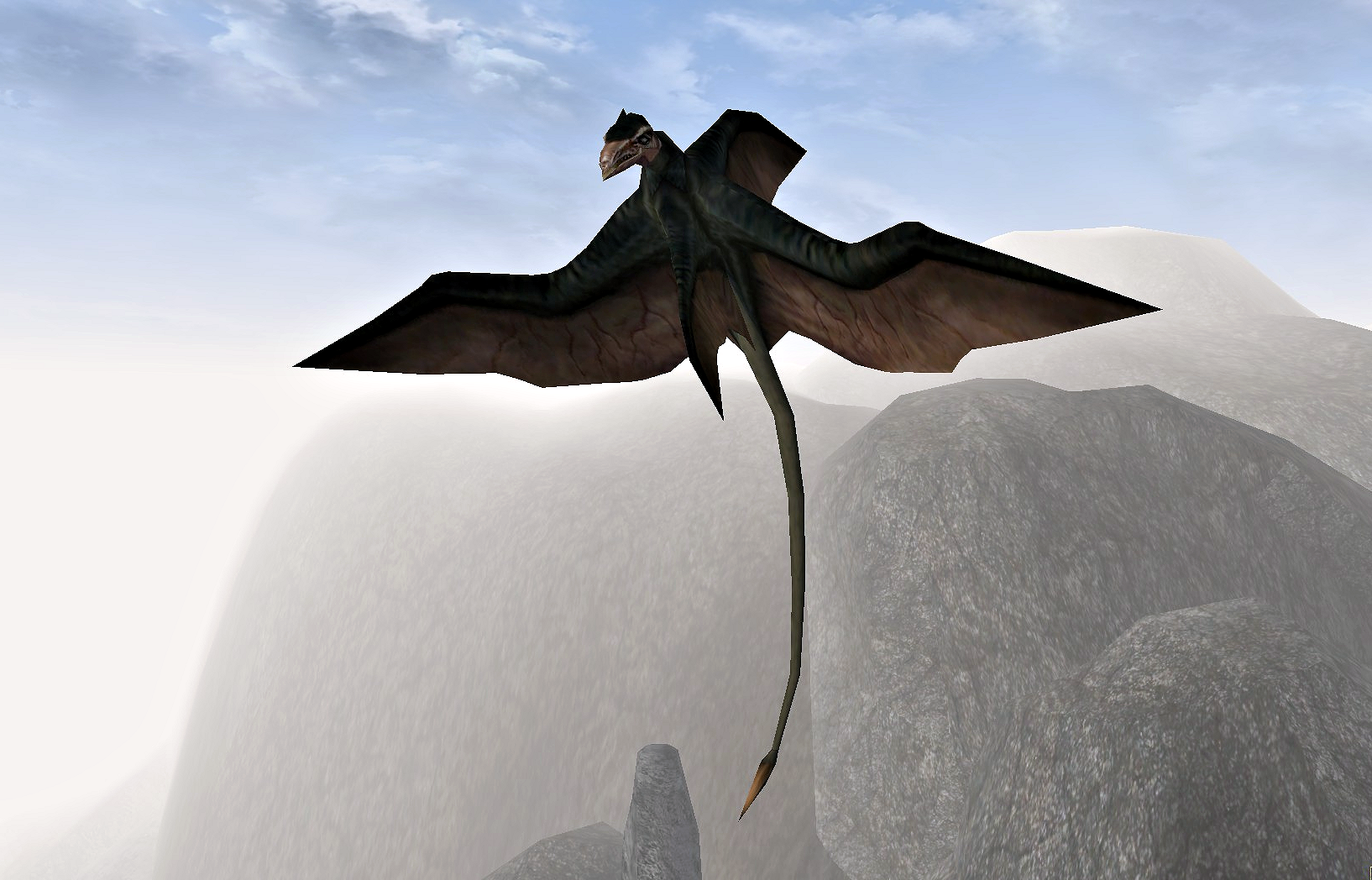
A cliff racer hovering above a precipice on Vvardenfell.
Taxonomic status
Kingdom Animalia; Phylum Chordata; Class Aves; Subclass Archaeornithes; Family Vvardidae; GenusCinis; Speciesdescendens
Conservation status
Least Concern [circa 3E 427]
Threatened [circa 4E 433]
Distribution
Once widespread throughout the north eastern region of Tamriel, occupying regions from the island of Vvardenfell to mainland Morrowind and Solstheim. Despite their name, the cliff racer is found across nearly all geographic regions of Vvardenfell, although the species is found in greatest densities in the rocky interior region of Stonefalls.
Following a purge of the species as part of pest control management, the cliff racer was effectively exterminated from parts of its range, including local extinction on the island of Solstheim. Since the cull the cliff racer is much less abundant throughout its range although still distributed throughout much of Vvardenfell and mainland Morrowind.
The province of Morrowind, which largely contains the distribution of the cliff racer. The island of Solstheim is found to the northwest of the map (the lower half of the island can be seen in brown).
Habitat
Although, much as the name suggests, the cliff racer prefers rocky outcroppings and mountainous regions in which it can build its nest, the species is frequently seen in lowland swamp and plains regions of Morrowind.
Behaviour and ecology
The cliff racer is a highly aggressive ambush predator, using height and range to descend on unsuspecting victims and lashing at them with its long, sharp tail. Although preferring to predate on small rodents and insects (such as kwama), cliff racers have been known to attack much larger beasts such as agouti and guar if provoked or desperate. The highly territorial nature of cliff racer means that they often attack travellers, even if they pose no immediate threat or have done nothing to provoke the animal.
A cliff racer descends upon its prey.
Despite the territoriality of cliff racers, large flocks of them can often be found in the higher altitude regions of Vvardenfell, perhaps facilitated by an abundance of food (reducing competition) or communal breeding grounds. Attempts by researchers to study these aggregations have been limited due to constant attacks and damage to equipment by the flock.
Following the control measures implemented, the population size of these populations of cliff racers declined severely; however, given the survival of the majority of the population it does not appear this bottleneck has severely impacted the longevity of the species. The extirpation of the Solstheim population of cliff racers likely removed a unique ESU from the species, given the relative isolation of the island. Whether the island will be recolonised in time by Vvardenfell cliff racers is unknown, although the presence of any cliff racers back onto Solstheim would likely be met with strong opposition from the local peoples.
Adaptive traits
The broad wings, dorsal sail and long tail allow the cliff racer to travel large distances in the air, serving them well in hunting behaviour. The drawback of this is that, if hunting during the middle hours of the day, the cliff racer leaves an imposing shadow on the ground and silhouette in the sky, often alerting aware prey to their presence. That said, the speed of descent and disorienting cry of the animal often startles prey long enough for the cliff racer to attack.
The plumes of the cliff racer are a well-sought-after commodity by local peoples, used in the creation of garments and household items. Whether these plumes serve any adaptive purpose (such as sexual selection through mate signalling) is unknown, given the difficulties with studying wild cliff racer behaviour.
Management actions
Although suffering from a strong population bottleneck after the purge, the cliff racer is still relatively abundant across much of its range and maintains somewhat stable size. Management and population control of the cliff racer is necessary across the full distribution of the species to prevent strong recovery and maintain public safety and ecosystem balance. Breeding or rescuing cliff racers is strictly forbidden and the species has been widely declared as ‘native pest’, despite the somewhat oxymoron nature of the phrase.
Emotion and spirituality are concepts that inherently seem at odds with the fundamentally stoic, empirical nature of scientific research. Science is based on a rigorous system of objectivity, repeatability and empiricism that, at face value, appears to completely disregard subjective aspects such as emotion, spirituality or religion. But in the same way that this drives the division of art from science, removing these subjective components of science can take away some of the personal significance and driving factors of scientific discipline.
Emotions as a driving force in science
For many scientists, emotional responses to inquiry, curiosity and connection are important components of their initial drive to study science in the first place. The natural curiosity of humanity, the absolute desire to know and understand the world around us, is fundamental to scientific advancement (and is a likely source of science as a concept in the first place). We care deeply about understanding many aspects of the natural world, and for many there is a strong emotional connection to our study fields. Scientists are fundamentally drawn to this career path based on some kind of emotional desire to better understand it.
Although it’s likely a massive cliché, Contactis one of my favourite science-fiction movies for simultaneously tackling faith, emotion, rationality, and scientific progress. And no doubt any literary student could dissect these various themes over and over and discuss exactly how the movie balances the opposing concepts of faith in the divine and scientific inquiry (and the overlap of the two). But for me, the most heartfelt aspect the movie is the portrayal of Ellie Arroway: a person who is insatiably driven to science, to the point of sacrificing many things in her life (including faith). But she’s innately an emotional person; when her perspectives are challenged by her observations, it’s a profound moment for her as a person. Ellie, to me, represents scientists pretty well: passionate, driven, idealistic but rational and objective as best as she can be. These traits make her very admirable (and a great protagonist, as far as I’m concerned).
Also, Jodie Foster is an amazing actress.
I would not, under ordinary circumstances, consider myself to be particularly sentimental or spiritual. I don’t believe in many spiritual concepts (including theism, the afterlife, or concepts of a ‘soul’), and try to handle life as rationally and objectively as I can (sometimes not very successful given my mental health). But I can’t even remotely deny that there is a strong emotional or spiritual attachment to my field of science. Without delving too much into my own personal narrative (at the risk of being a little self-absorbed and pretentious; it’s also been covered a little in another post), the emotional connection I share with the life of Earth is definitely something that drove me to study biology and evolution. The sense of wonder and curiosity at observing the myriad of creatures and natural selection can concoct. The shared feeling of being alive in all of its aspects. The mystery of the world being seen through eyes very different to ours.
More shameless self-promotion of my own artwork. You’ll notice that most of my art includes some science-based aspects (usually related to biology/evolution/genetics), largely because that’s what inspires me. Feeling passionate and emotional about science drives both my artistic and scientific sides.
Attachment to the natural world
I’d guess that there are many people who say they feel a connection to nature and animals in some form or another. I definitely think this is the case for many biologists of various disciplines: an emotional connection to the natural world is a strong catalyst for curiosity and it’s no surprise that this could develop later in life to a scientific career. For some scientists, an emotional attachment to a particular taxonomic group is a defining driving force in their choice of academic career; science provides a platform to understand, conserve and protect the species we hold most dear.
Although it’s of course always better to frame an argument or present research in an objective, rational matter, people have a tendency to respond well to appeal to emotion. In this sense, presenting scientific research as something that can be evocative, powerful and emotional is, in my belief, a good tactic to get the general public invested in science. Getting people to care about our research, our study species, and our findings is a difficult task but one that is absolutely necessary for the longevity and development of science at both the national and global level.
Pretending the science is emotionless and apathetic is counterproductive to the very things that drove us to do the science in the first place. Although we should attempt to be aware of, and distance, our emotions from the objective, data-based analysis of our research, admitting and demonstrating our passions (and why we feel so passionate) is critical in distilling science into the general population. Science should be done rationally and objectively but driven by emotional characteristics such as wonder, curiosity and fascination.
A fellow science student once drunkenly said that “I am a biologist…I don’t understand art.” Although somewhat bemusing (both in and out of context), it raises a particular philosophical idea that I can’t agree with: that art and science directly contradict one another.
It’s a somewhat clichéd paradigm that art and science must work at odds with one another. The idea that art embraces emotion, creativity and abstract perception whilst science is solely dictated by rationality, methodology and universal statistics is one that still seems to be somewhat pervasive throughout society and culture. While there seems to be a more recent shift against this, with both ends of the spectrum acknowledging the importance of the other in their respective fields, the intersection of art and science has a long and productive history.
A piece I did for a high school assignment some years ago. The artwork was meant to be the visual representation of Edgar Allen Poe’s 1829 poem “Sonnet- To Science“, by showing the dichotomy of the beauty of the natural world (left) vs. the cold, rigorousness of science (right).
Typically, the disjunction from the emotional and evocative state of people with science is through how the science is written. In many formats (particularly for the most widely used scientific journals), artistic and emotional writing is seen to detract from the overall message and objectivity of the piece itself. And while appeal to emotion can certainly take away from or mislead the message of the writing, it’s important to connect and attract readers to the work in the first place. Trying to find a possible avenue to work in personal style and artistry into an academic paper is an incredibly difficult affair. This is a large contributor to the merit of non-journalistic forms of scientific communication such as books, poetry and even blogs (this was one motivator in starting this blog, in fact).
It might come as a surprise to readers that I love art quite a lot, especially given the (lack of) quality of the drawings in this blog. But I’ve always tried to flex my creative side and particular when I was a younger was a more avid writer and sketcher. And that truth of the matter is that I don’t feel that the artistic side of a person has to be at odds with their scientific side. In fact, the two directly complement each other by linking our rational, objective understanding of the world with the emotional, expressive and ideological aspects of the human personality.
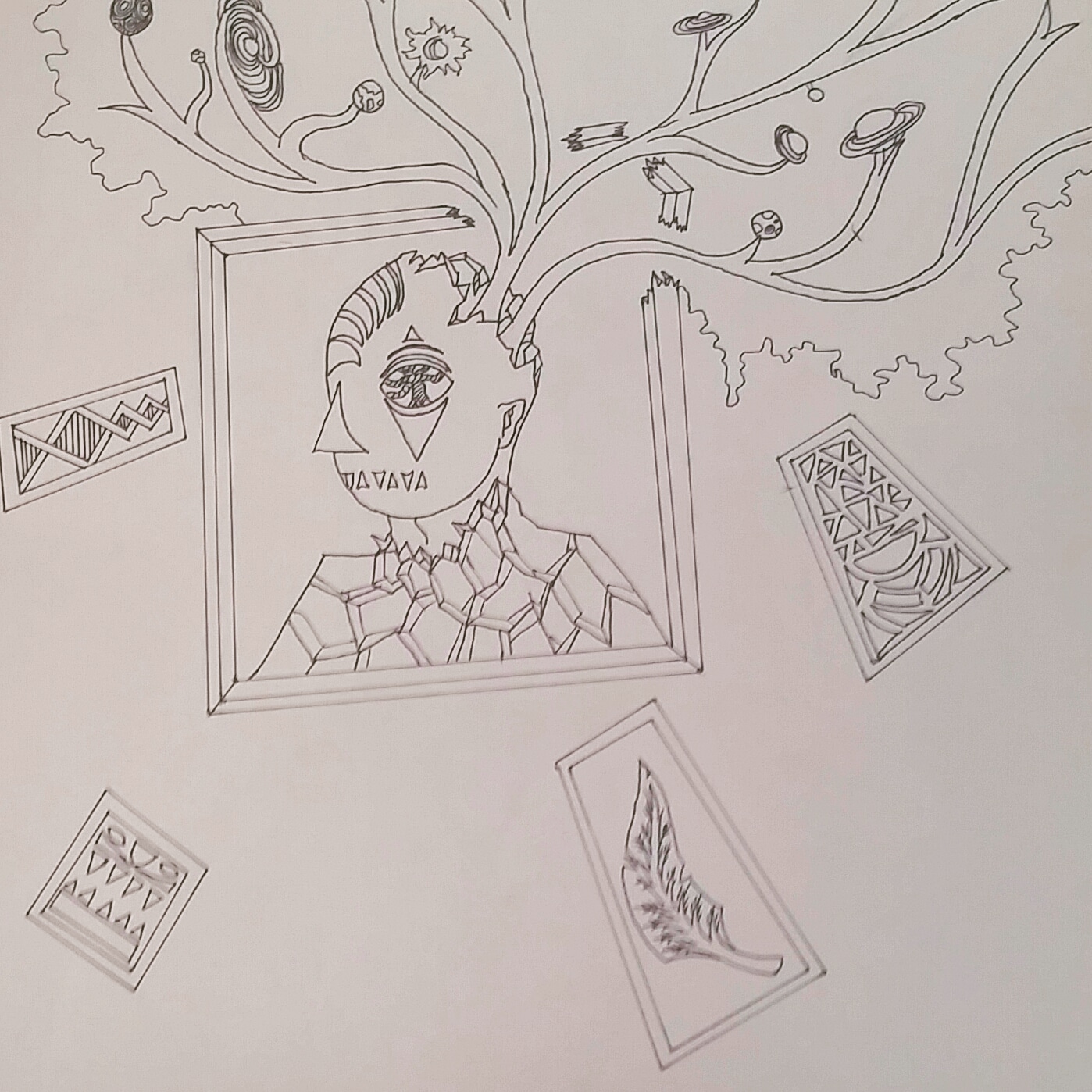
My own (non-blog) artwork tends to combine both imagery from the natural world and more emotional themes (e.g. mental health).
The art of science
From one angle, science is actively driven by creativity, ambition and often abstract ideation. The desire to delve deep to find new knowledge is intrinsically an emotional and philosophical process and to pretend that science is devoid of passion discredits both the research and the researcher. Entire disciplines of biology, for example, find themselves driven by science and people with deep emotional connections to the natural world and a desire to both understand and protect the diversity of life. The works of John Gould in his explorations of the Australian biota remain some of my favourites for both scientific and artistic merit.
The science of art
From the other direction, science can also inform artistic works by expanding the human knowledge and experience with which to draw inspiration from. Naturally, this is an intrinsic part of genres such as science fiction, but many works of horror, abstraction, fantasy, thriller also draw on theories and revolutions brought about by scientific discovery. The further we understand the processes of the universe through scientific discovery, the greater the context and extent of our philosophical and emotional perspectives can be allowed to vary.
A piece by local artist and good friend of mine (and also the designer of The G-CAT logo!) Michelle Fedornak. She describes her piece (dubbed ‘We Are All Stars’) as inspired by the explorations of the Mars Curiosity rover and tackles themes of identity and isolation in the galactic space. Thus, her work combines the philosophical and emotional side of scientific exploration with the artistry and consciousness of human identity.
Unity
Gone are the days of dichotomy between 18-19th Century Impressionism and Enlightenment. Instead, the unity of science and art in the modern world can have significant positive contributions to both fields. Although there are still some elements of resistance between the two avenues, it is my belief that by allowing the intrinsically emotional nature of science to be expressed (albeit moderated by reason and logic) will allow science to influence a greater number of people, an especially important connection in the age of cynicism.







 The G-cat